


AI in Housing: IoT Sensors for Damp and Mould
One of the most practical examples of AI in housing today is the use of IoT (Internet of Things) sensors to detect damp and mould risk at an early stage.
This approach has gained significant momentum in UK social housing, particularly following increased regulatory focus and expectations around faster intervention, including “Awaab’s Law.” The emphasis has shifted from reacting to visible mould to identifying risk conditions before damage occurs.
IoT systems achieve this by continuously monitoring environmental conditions inside properties and translating them into early warning signals.
Commonly used platforms include Aico HomeLINK, Switchee, Vericon Systems, Wondrwall, and North Smart Sensors.
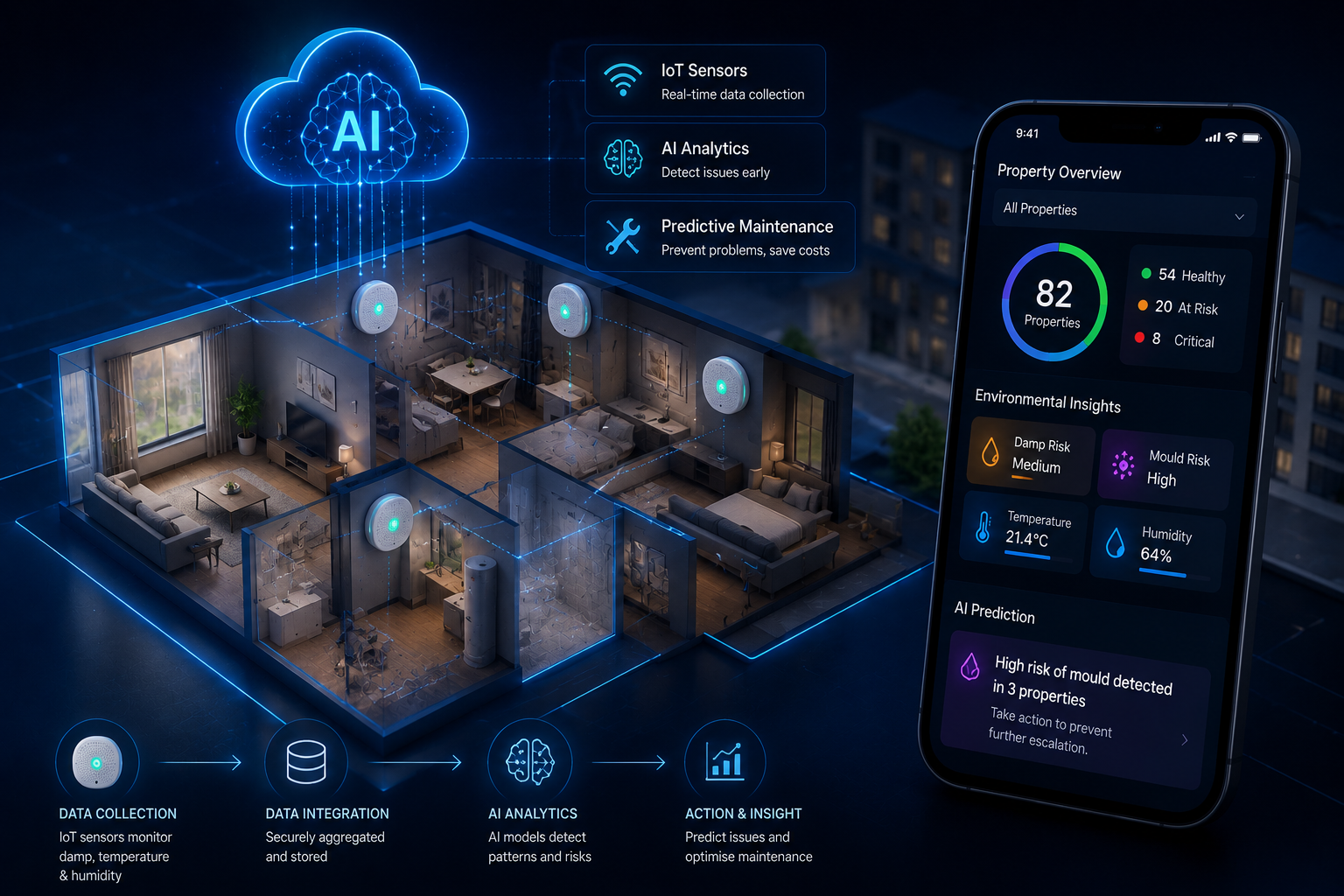
What IoT Damp and Mould Systems Measure
These systems continuously collect structured environmental data such as:
- Humidity and temperature levels
- Condensation and dew-point risk
- Indoor air quality and CO₂ levels
- Moisture indicators in some installations
- Occupancy and ventilation patterns
This creates a continuous, time-based view of conditions inside each property.
How IoT Data Becomes Predictive Insight
The value of IoT systems lies in interpretation, not just measurement.
AI models analyse environmental patterns to identify:
- Persistent humidity build-up
- Temperature conditions that lead to condensation
- Poor ventilation behaviour
- Cold-home indicators
- Early signs of structural damp risk
This allows housing providers to receive alerts before issues become visible or are reported by tenants.

What This Reveals About Housing Data Readiness
IoT damp and mould systems provide a clear example of what AI-ready housing data should look like:
- Continuous data collection over time
- Standardised environmental measurements
- Strong links between property, condition, and risk
- Structured outputs designed for decision-making
- Integration between environmental and operational data
When housing data lacks this structure, predictive models built on traditional systems often lose accuracy and reliability.
From IoT Monitoring to Predictive Maintenance
When IoT environmental data is combined with structured housing records, organisations can move towards true predictive maintenance.
This enables:
- Earlier detection of housing risks
- Fewer emergency repairs
- More efficient maintenance planning
- Stronger compliance evidence
- Improved resident wellbeing
In this model, data becomes an active tool for decision-making rather than a passive record.
Final Thoughts
AI in housing is not constrained by technology—it is constrained by data readiness. IoT damp and mould monitoring clearly demonstrates how structured, continuous data can transform reactive processes into predictive insight.
Ultimately, preparing housing data for AI is about building a consistent and connected foundation, enabling insights that are not only accurate but also actionable at scale.